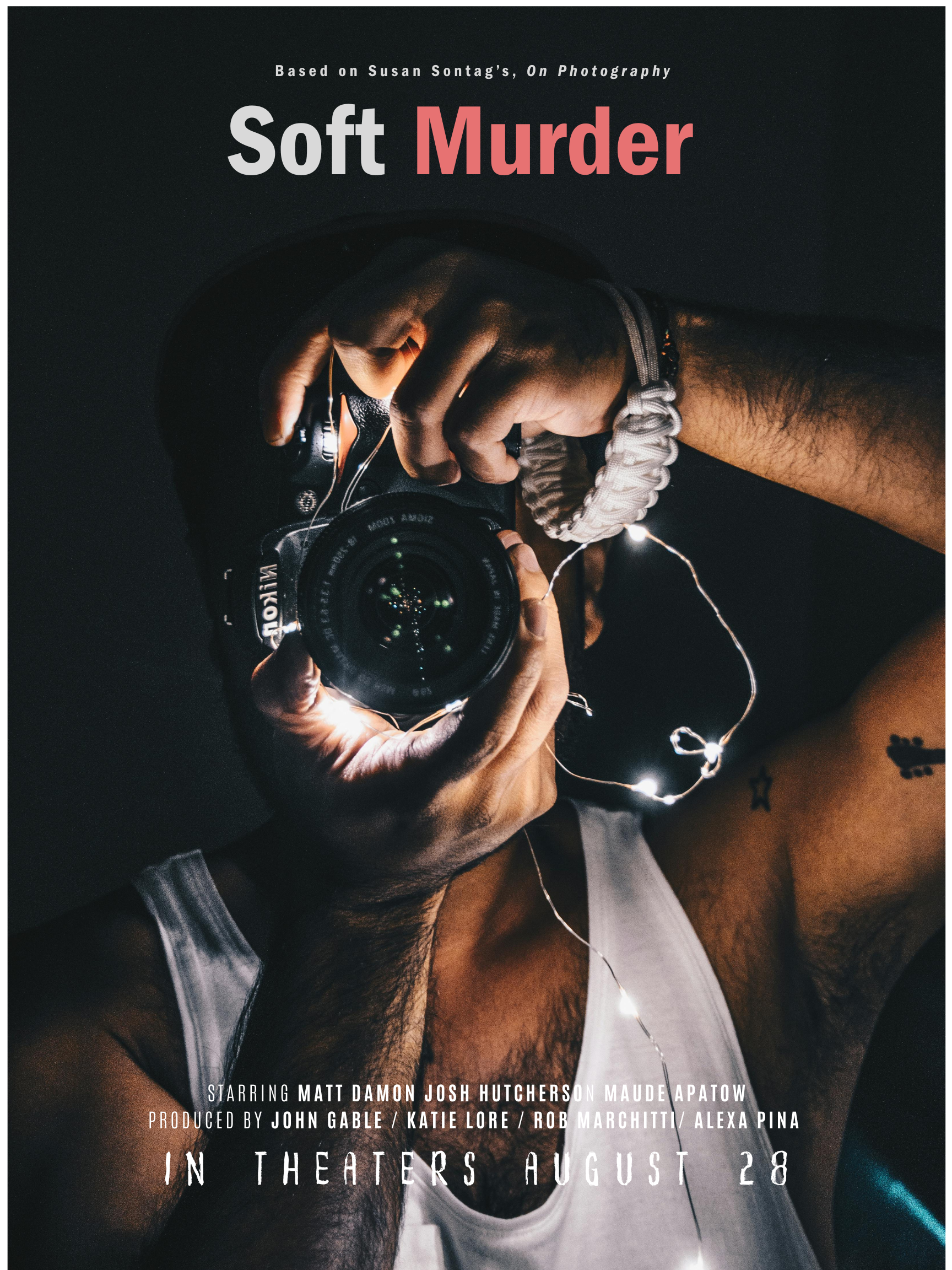
For my movie poster I used the phrase “soft murder” from Susan Sontag’s On Photography, a striking term she uses to describe the act of photographing people. The full passage reads: "Just as the camera is a sublimation of the gun, to photograph someone is a sublimated murder–a soft murder, appropriate to a sad, frightened time” (Sontag 14). I was extremely intrigued by this phrase and by Sontag’s overall perspective on photography–that taking someone’s photograph is a kind of intrusion or violation. She suggests that, although there is no physical harm in photographing someone, there is still a predatory element to it: that the photographer has power over the subject since the subject has no control over how they are represented, and that photographing someone–to possess their image–also means to objectify them. It captures a moment of the subject’s life and turns it into the photographer’s object, removing it from its original context to use for the photographer’s own purpose. Similar to how murder takes someone’s life, photography takes the authenticity and truth from a person and how they are both represented and perceived.
In order to portray this idea, I made my hypothetical movie to be a thriller where a stalker lurks in the shadows so he can take photographs of his targets, making the moment he photographed no longer theirs but his property. I felt that making it a thriller, as well having the dark background, portrayed the invasiveness of photography pretty well since it looks like the man is hiding in the darkness with his camera, able to take a photograph at any given moment without the subject’s knowledge. In addition, I decided to make the title two different colors: ‘Soft’ being white while ‘Murder’ is red so that there would be an emphasis and predatory feel while reading ‘murder’. I also chose the bold and block-ish font, ITC Franklin Gothic LT Condensed, for the title as I wanted to evoke the intensity, suspense, and seriousness of the film. Lastly, I really liked how the camera looks directly at the viewer head on, almost as if the man is staring into the viewer’s eyes through the camera, ready to take a picture of them. I felt that this captured the feeling that the viewer had no choice but to be photographed–that their choice was taken from them, which further implies how people are unable to pick how they are represented when someone takes a picture of them.